Coalition Against Duck Shooting Commission Report (Posted 14/11/07)
MAJORITY OF VICTORIANS WANT DUCK SHOOTING BANNED
A large majority of Victorians (75%) think that the shooting of native water birds for recreational purposes should be banned in Victoria. Twenty percent think it should not be banned, and 5% are undecided, a survey conducted by Roy Morgan Research has found.
When informed that due to drought and climate change, the numbers of native water birds across eastern Australia have dropped by over 80%, that at least one in four native water birds shot at are wounded, and that duck shooting has been banned in WA, NSW and Queensland, the proportion of Victorians who want to see the activity banned increases to 87%. Then just 10% of Victorians think it should not be banned, and 3% remain undecided.
With the State Government soon to decide whether the 2008 duck shooting season will proceed, analysis by State voting intention shows that almost all supporters of The Greens (98%) support a ban on the shooting of native water birds. Large majorities of ALP supporters (87%) and supporters of Other Parties/Independent Candidates (84%) and L-NP supporters (83%) also want to see the activity banned.
Those living in Melbourne (91%) were more likely than those in country areas to think the shooting of native water birds should be banned, but even in country areas an overwhelming majority (77%) think the activity should be banned.
The survey was conducted amongst a representative cross-sectional sample of 637 Victorians aged 14 years and over to between October 3 and 27, 2007.
This survey was conducted by Roy Morgan Research on behalf of the Coalition Against Duck Shooting and Voiceless.
To add your voice to this issue you could write or email the following people:
Gavin Jennings, Environment Minister,
Level 22, 50 Lonsdale Street
Melbourne Vic 3000
gavin.jennings@parliament.vic.gov.au
Premier John Brumby
1 Treasury Place
Melbourne Vic 3002
John.brumby@parliament.vic.gov.au
New home for the bats (17th April 2007)
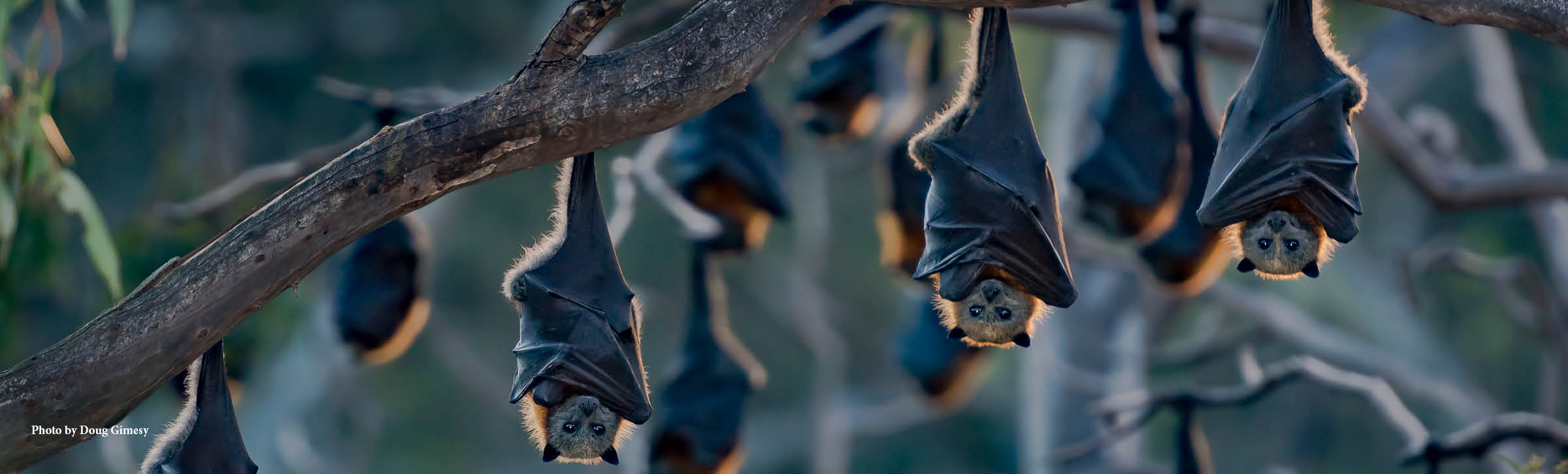
Wildlife Victoria has recently purchased a bat aviary for our juvenile Grey Headed Flying Foxes to learn the fine art of flying in. The cleverly designed aviary is a tent-like structure made out of the same netting used for practice nets for cricket. The bats love flying full pelt from one end of the aviary to the other, crashing into the netting at the end and turning around and flying back.
The aviary was purchased with money given to Wildlife Victoria from court-orderedfinesfrom three youths who were caught firing missiles into the colony of protected flying foxes. We thought it appropriate that the money went back to help the colony out.

Sandy, the Grey Headed Flying Fox tries out his wingspan in the new aviary.
Volunteers Tackle Problem (3rd June 2006)
Newport in Melbourne is a veritable mine field for our seabirds and other wildlife visiting the area. Strewn all over is discarded fishing line and hooks and other pollutants left by thoughtless visitors to the area. Wildlife Victoria volunteer rescuer, Mandy Hall, who spends hours saving the birds in the area, decided enough was enough. Volunteers and Friends of Wildlife Victoria went out on a cold and frosty morning recently to pick up the rubbish.
Mandy Hall debriefs volunteers on safety before the start of the clean up.
This small band of dedicated people commenced at 10am, a short lunch break (lunch provided by Hobson City Council) and back out till 4pm and the results were staggering. The skip containing the rubbish was surprisingly full and the amount of fishing tackle collected was enough to make you wonder how any bird could avoid entaglement.
Fishing line entangled around the foot
One bird that was not so lucky was the seagull that the volunteers noticed on the day. After a quick capture the bird was found to have line entangled around its foot causing swelling (eventually this would have caused the foot to loose all circulation and drop off). This line was attached to a hook embedded in its skin under its wing, unfortunately for this bird there was another line entangled around its beak and as the volunteers unravelled that line they found the other end disappeared inside the bird's mouth. This bird was rushed to the local vet who, unfortunately, had no choice but to euthanaise it.
Just the fishing lines and hooks shown here, the bulk went in the skip.
Deaths like these need not happen if everyone who visited our waterways treated them with respect, taking home their rubbish and especially their fishing line. Once home the fishing line can be discarded by cutting it into very small peices and placing it into the bin. Fishing line, any longer than 5cm long can be a death trap for our wildlife and if you take it to the park area it is your responsibility to take it home with you.
Congratulations and well done to the dedicated volunteers on the day, a brilliant effort and with the amount of debris collected we can certainly say we saved many birds that day.
More pictures can be seen by clicking here.
New Staff for Wildlife Victoria (May 2006)
Wildlife Victoria recently were awarded funds to pay for our very first full-time staff member for 12 months. The funds came through the Vodafone World of Difference Program and were awarded to Sandy Fernee. Sandy's goals for the year are to project manage the Mange in Wombats Research Project, work on a solution to the Grey Headed Flying Fox rehabilitation problems and to conitnue to coordinate Wildline. We look forward to an exciting year ahead.
Sesame gets a reprieve (April 2006)
Wildlife Victoria recently were called out to rescue an emu that had found his way onto a farm property just north of Melbourne. This area is traditionally an emu habitat area however they have not been there for a very long time due to settlement. With this knowledge we knew 'Emu' was probably an escaped farm bird, however the local emu farmer had shown no interest and that was when Wildlife Victoria was called in. 'Emu' was loaded onto a borrowed horse float and began his journey to his new home. Arriving at Hepburn Wildlife Shelter he was prmptly named Sesame (Big Bird) and settled very calmly into a very luxurious life (for an emu). You can see photos of Sesame enjoying a mud bath on Wildlife Victoria's Flickr site. Photo 1, Photo 2, Photo 3.
Opening of Duck Shooting Season 18th March 2006
Wildlife Victoria supported the Coalition Against Duck Shooting once again by supplying veterinary care for ducks brought into care. Wildlife Victoria set up it's emergency trailer on the side of Lake Murphy near Kerang (Photo). Many of the ducks were brought in because shooters did not collect them (once they reach their bag limit they are suppsed to stop). Some were still alive on arival at the triage and would have died long and painful deaths if they had not been collected by volunteers. Mostly we had Pink Ear ducks brought in, all but one were either dead or had to be euthanaised (Photo). One duck, brought to triage had minor wounds and we were able to release him onto one of the protected lakes. Four endangered species were shot and protected Black Swans were also collected by the coalition, including one cygnet.
If you would like to let our environment minister know that duck shooting needs to be stopped please email to John Thwaites.
Queen's Baton Relay
Wildlife Victoria member Manfred Zabinskas was chosen to run with the Queen's Baton the day preceeding the opening of the Commonwealth Games in Melbourne. Manfred said it was a privilege to run on behalf of all wildlife carers (this is not what he said when he first saw the hill he had to run up).
2006 Bushfires
Wildlife Victoria initiated a state-wide campaign to raise money for and awareness of the animals that were tragically injured in the recent bushfires that raged throughout Victoria. Generous support from the community means that we are able to support the shelter operators whose vet, supplies and other bills have become astranomical with the influx of injured wildlife.
If you are a registered shelter or foster carer then please email info@wildlifevictoria.org.au for a reimbursement form.
Koalas were very hard hit in the fires, many coming in with burns to their feet and paws. Here 'Bear'is given good care from Marilyn. Bear came out of the Brisbane Ranges fires.
Kids' Club
Wildlife Victoria's Kids' Club started up this year (2006) and we are very excited that kids will now be able to belong to Wildlife Victoria. Kids Club has been set up to help kids understand better our environment and how everyone can affect it for the better. Kids will be able to take part in competitions, learn interesting things about wildlife and each child will have their own Kids' Club membership card with a picture of Kids Club mascot Flint the Wombat.
If you are interested in Kids' Club then email Miss Mandycakes on kidsclub@wildlifevictoria.org.au
Manfred & Donna Zabinskas Awarded Pride of Australia Award
Wildlife Victoria congratulates members Donna and Manfred Zabinskas on recently winning a Pride of Australia medal in the environmental section. Manfred accepted the award on behalf of all wildlife carers.